Why Do Children Hesitate to Ask Questions in Class?
posted on Nov 11, 2026
Discover why children hesitate to ask questions in class and how parents and teachers can build their confidence, curiosity, and communication skills.
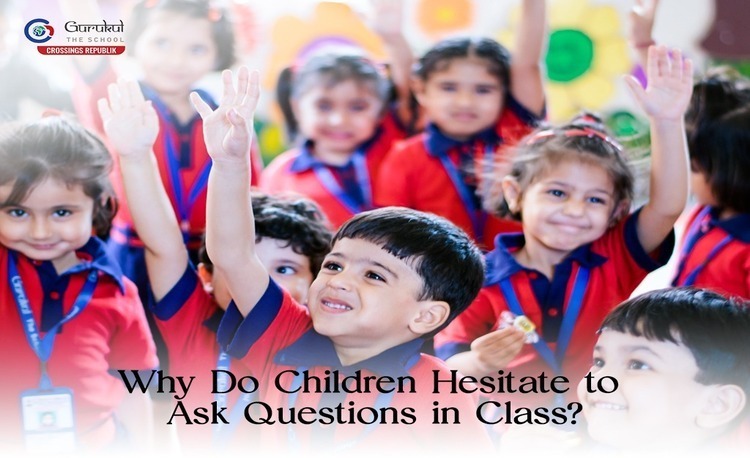
At home, your child asks question after question. Why is the sky blue? Where do birds go at night? Why can’t we have ice cream for dinner? Yet at the parent-teacher meeting, you hear something quite different: ‘They rarely ask questions in class.’
For many parents, this is puzzling. How can a curious child become so quiet at school? The answer usually has less to do with curiosity and more to do with how safe the child feels speaking up in front of others.
At Gurukul The School, Crossing Republik, one of the top schools in Crossing Republik, Ghaziabad, we see questions as a sign that learning is taking place. A question shows that a child is thinking, noticing gaps, and trying to make sense of something new.
In this blog post today, let us explore why some children hold back their questions and how parents and teachers can help them find their voice.
Why Do Questions Matter So Much in Learning?
When a child asks why we carry over in addition, they are not simply asking for the steps. They are trying to understand why the method works. That understanding stays with them far longer than a rule memorised without meaning.
Questions also tell teachers what children are thinking. A single question can reveal that a student has mixed up two ideas or has already moved ahead to a more advanced concept. Without these questions, a teacher has fewer clues about where support is needed.
Most importantly, asking questions is a habit. Children who learn to ask questions in the early years are more likely to keep doing so as subjects become more complex.
What Stops Children From Asking Questions?
Fear of looking foolish
A child may worry that their question is too simple or that everyone else already knows the answer. A single experience of classmates laughing can be enough to keep them silent for weeks.
Uncertainty about what to ask
Sometimes a child knows they are confused but cannot identify exactly what they don’t understand. Saying ‘I don’t get it’ feels vague, so they say nothing at all.
Feeling rushed
If a lesson moves quickly from one point to the next, a child may not find a natural moment to raise their hand. By the time they are ready, the class has moved on.
Believing that good students don’t need help
Some children, especially those who usually do well, see asking a question as admitting weakness. They would rather work out the answer on their own than risk seeming unsure.
A quieter temperament
Not every child is comfortable speaking in a large group. A quieter child may have plenty of questions but prefer to ask them one-on-one or in a small group.
How Can Parents Encourage Questions at Home?
1. Respond with interest, even when you are busy
If a question comes at an inconvenient moment, try saying, ‘That’s a good question. Let’s talk about it after dinner.’ Then remember to return to it. This shows your child that the question was worth asking.
2. Admit when you don’t know
Saying ‘I’m not sure. Let’s find out together’ teaches children that not knowing is a normal part of learning. Looking up the answer together can become an enjoyable activity in itself.
3. Ask open-ended questions yourself
Instead of asking whether they had a good day, try ‘What surprised you today?’ or ‘Was there anything in class that confused you?’ These questions invite thinking rather than a one-word reply.
4. Practise turning confusion into a question
If your child says, ‘I don’t understand fractions’, ask them to point to the exact step where they got stuck. Together, you might arrive at a clearer question, such as ‘Why does the bottom number stay the same when we add these fractions?’
5. Praise the question, not just the answer
A remark like ‘That question made me think’ tells your child that curiosity is valued. Over time, they begin to see questions as something to be proud of.
How Do We Encourage Our Students to Ask Questions?
At Gurukul The School, Crossing Republik, we believe children ask more questions when they trust that their questions will be welcomed. Our teachers make a point of responding to every question with respect, whether it concerns a key concept or a small detail.
We also create different ways for children to speak up. Some students are comfortable raising their hand in front of the class. Others prefer to ask during group work or after the lesson. Offering these options allows quieter children to participate in a way that suits them.
Self-expression is part of the wider school experience, too. Kathashala, our storytelling space, encourages imagination, narrative thinking, and self-expression. When children grow used to sharing ideas and stories, asking a question in class can begin to feel less daunting.
Finally, we keep parents involved. Through our monthly Sunshine Calls, teachers and parents can discuss how a child participates in class and what might help them feel more confident. A parent may share that their child asks many questions at home, which helps the teacher see that the curiosity is already there.
Frequently Asked Questions (FAQs)
Q. My child is shy. Should I push them to speak up in class?
Gentle encouragement helps more than pressure. Start by helping them ask questions in smaller, familiar settings, and then build up gradually.
Q. What if my child asks the same question repeatedly?
Repeated questions often mean that the explanation hasn’t fully connected yet. Try explaining the idea differently, using an example or a drawing.
Q. Is it a problem if my child never asks questions?
Not necessarily, but it is worth exploring. Ask the teacher how your child participates in other ways, such as through group work or written tasks.
Q. How should I respond when I don’t know the answer?
Say so honestly, and look for the answer together in a book, on a reliable website, or by asking someone who knows.
Q. Can too many questions disrupt learning?
Occasionally, a child may need help choosing the right moment to ask. Teaching them to note down a question and raise it later is more useful than discouraging questions altogether.
Conclusion
A child who asks questions is a child who is thinking. Whether the question is about the planets, a mathematics problem, or the meaning of a new word, it shows a willingness to learn that deserves encouragement.
At Gurukul The School, one of the top schools in Crossing Republik, Ghaziabad, we want every child to feel that their questions belong in the classroom. When children trust that they will be heard, they become more willing to take part, admit what they don’t understand, and explore ideas further. The way a school responds to children’s questions says a great deal about how learning happens there.
We welcome you to speak with our team about how we encourage curiosity and confident participation in our classrooms.